
Framework for Results-driven AI Management in Enterprise
Because “just add AI” was never a strategy.
TL;DR
Methodology first. Tooling second.
Most AI projects fail not because the technology doesn't work, but because organizations commit to building before they've checked whether the right problem has been chosen, the data and systems can support it, and the people who depend on the existing process are prepared to work differently.
FRAME performs those checks first, then guides integration through controlled, reversible stages so AI is introduced without disrupting day-to-day operations. Each engagement defines its own success metrics across four value categories — efficiency, quality, risk, and decision-making.
The two gaps
Why most AI projects fail.
More than 80% of AI projects fail — twice the rate of non-AI IT. 95% of enterprise GenAI pilots produce no measurable profit impact at all.
These failures cluster in two distinct gaps, and most organizations are caught in both.
The Selection Gap
Choosing the wrong problem before building.
Stakeholders misunderstand which problem AI should solve. Teams lead with technology instead of problem fit. Tools get deployed — chatbots, automated workflows, GPT wrappers — that are technically functional but solve a problem the business doesn't have, or solve it where the data can't support it.
The Integration Gap
Failing to connect AI to existing systems and workflows.
Even when the right problem is chosen, projects stall because data flows are unclear, there's no plan for what happens when the AI gets it wrong, governance is absent, and the rollout disrupts the business it was meant to improve.
Both gaps must be closed in sequence. Skipping Selection produces well-integrated solutions to the wrong problem. Skipping Integration produces well-chosen ideas that never operate at scale.
Six-layer methodology
Value-gated progression.
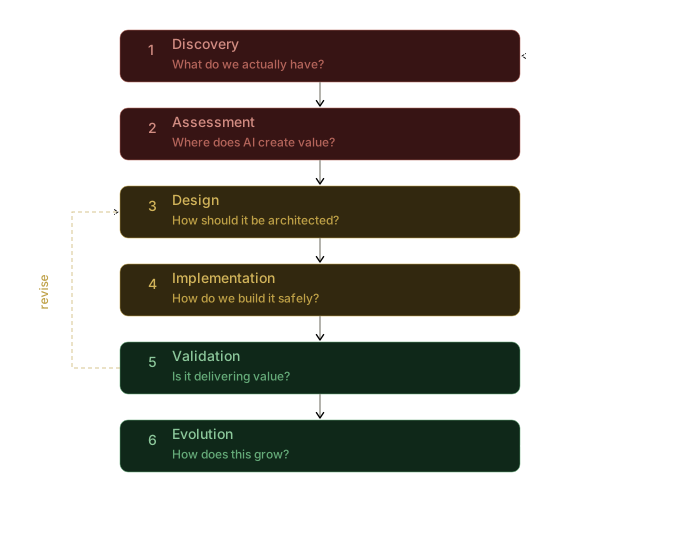
Each stage answers a question that must be resolved before the next becomes relevant. No layer advances without exit criteria — validated evidence that the opportunities are genuine and the infrastructure is ready. This prevents the most common failure: building on a foundation that isn't ready.
- 1
Discovery
What does our current operation actually look like?
- 2
Assessment
Where would AI genuinely improve how we work?
- 3
Design
How should the connection between AI and our systems be set up?
- 4
Implementation
How do we introduce it safely and in stages?
- 5
Validation
Is it producing the results we expected?
- 6
Evolution
How do we build on what works and continue improving?
Implementation
Four stages. Reversible at every step.
Layer 4 plays out in four controlled stages, each with explicit exit criteria. At every stage, the integration can be reverted to the prior state without business disruption.
- 1
Shadow
The AI runs alongside the existing process. Outputs are logged but not acted on. Accuracy is validated without operational risk.
- 2
Pilot
A narrow, low-stakes subset of real cases is handed to the AI under human review.
- 3
Limited rollout
Scope broadens while human-in-the-loop checkpoints and defined fallback paths remain in place.
- 4
Full deployment
Reached only after prior stages produce evidence the system performs reliably and the organization has adapted its workflow around it.
Discovery
Why the first stage matters most.
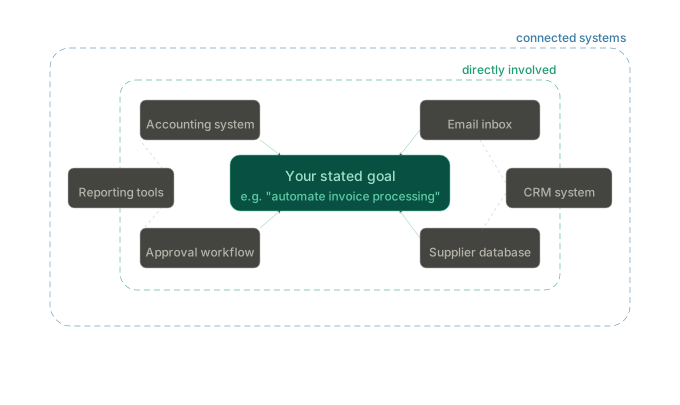
Most organizations don't have a complete picture of how their systems and processes connect. That's not a failure — it's the natural result of years of growth, changing tools, and practical workarounds becoming permanent. Nearly every organization we speak to is in this situation.
AI requires reliable access to data and clean connections to existing systems. When those connections are unclear or undocumented, even well-chosen solutions underperform or create unintended side effects.
Discovery can feel like overhead — or worse, an audit. For the people responsible for existing systems, it can feel threatening. FRAME avoids this by starting from the organization's own stated goal, not a top-down infrastructure review. Managers receive a roadmap for improvement — not a grade on current performance.
Five dimensions
What we actually look at.
Connectivity
Can the system exchange data with other software, and how? Determines whether AI can technically access it.
Data character
How clean, structured, and up-to-date is the information? Determines what AI can learn from and work with.
Process context
Who uses the system, how often, and what is the cost when something goes wrong? Determines where AI creates business value.
Governance profile
Who owns the data, what access controls exist, and do regulatory constraints apply? Determines what AI is permitted to do.
Change tolerance
How stable is the system, and how open is the organization to modifying how it works? Determines how safely AI can be introduced.
By mapping how data actually moves between systems across these dimensions, we identify specific integration points — where data transfers between systems, or where manual steps bridge a gap. These are the locations where AI has the highest potential to create value.
What Discovery produces
- System registry with readiness scores across all five dimensions.
- Data flow map showing how information actually moves between systems, including manual handoffs.
- Constraint register documenting regulatory and technical limitations.
- Discovery summary with key findings and next-stage recommendations.
Why AI needs its own methodology
Traditional frameworks weren't built for probabilistic systems.
TOGAF for enterprise architecture, ITIL for IT service management — these were designed for traditional software, where systems are predictable: the same input always produces the same output.
AI doesn't work this way. It produces probable answers, not guaranteed ones. Performance can shift over time. Outputs can be plausible but incorrect. That requires governance built around probability and continuous change, not stability. This is why FRAME exists as a separate methodology rather than an extension of what came before.
Assessment
Sorting real opportunities from noise.
Assessment takes the overview from Discovery and determines which opportunities are genuine and which are not. Each potential AI application is evaluated on four criteria, then classified.
Four criteria
Value potential
How significant is the expected improvement across the four value categories — efficiency, quality, risk, and decision-making?
Data readiness
Is the required data accessible, structured, and of sufficient quality?
Technical feasibility
Can AI practically connect to the systems involved?
Organizational readiness
Are the affected teams prepared for a change in how they work?
Four categories
Quick win
High value, high feasibility. Ready to act on now; builds confidence and generates early evidence.
Strategic investment
High value, but requires preparation work before proceeding.
Watch list
Not ready today, but may become viable as readiness improves. Revisited in future cycles.
Not recommended
A fundamental limitation exists. Documented with rationale so the question isn't revisited later.
Documenting what not to pursue is a deliberate part of the methodology. It prevents repeated investment in dead ends and protects the organization's confidence in AI as a whole.
Design → Evolution
From plan to continuous improvement.
Design
Selects the integration approach, defines how data moves, and plans for reversal if needed.
Implementation
Introduces the solution in controlled stages, with explicit criteria that must be met before each next step.
Validation
Measures whether expected results materialise, using metrics defined before deployment.
Evolution
Reassesses infrastructure, updates the roadmap, and plans the next set of improvements.
Engagement
Two ways we work with you.
Every engagement begins with Discovery and Assessment. The methodology and platform are the same in every case; duration and depth depend on the organization's size and complexity.
Before any engagement begins, the organization is given access to the FRAME platform to provide baseline information — systems in use, ownership, how data moves between them. Our time together is then spent on analysis and judgment, not on collecting information you already have.
We lead
Our team drives the process, using the platform as the delivery tool. You participate throughout, gaining direct understanding of the methodology and your own infrastructure. This is how first engagements work.
We support
After one completed cycle, your team leads subsequent cycles — data collection, scoring, analysis. We review at each stage gate, challenge assumptions, and validate conclusions before the project advances.
Ongoing reviews
AI integrations are not static. Systems change, data evolves, priorities shift. Quarterly or semi-annual reviews assess whether existing integrations continue to perform and whether new opportunities have emerged. Every assessment, decision, and outcome is retained — each review builds on what came before.
The principle
Build capability, not dependency.
Our goal is to make your organization capable of managing its own AI integration — and remain available when you need a second perspective or enter a new area of the business.
Adopting FRAME is an evolution of organizational capability. Our five-level Maturity Model provides the roadmap: from initial exploration through piloting and scaling, to a state where AI integration becomes a continuous cycle of growth.
References
Yes, of course we have references.
- The root causes of failure for artificial intelligence projects and how they can succeedRyseff, J., De Bruhl, B. F., & Newberry, S. J. — RAND Corporation (2024)
- The GenAI divide: State of AI in business 2025Challapally, A., Pease, C., Raskar, R., & Chari, P. — MIT NANDA (2025)
- 30% of generative AI projects will be abandoned after proof of concept by end of 2025Press release — Gartner (2024)
- The TOGAF® standard, 10th editionThe Open Group (2022)
- ITIL Foundation: ITIL 4 editionThe Stationery Office — AXELOS (2019)
Ready to move beyond the pilot phase?
Let's talk about how FRAME can work for your organization.